Most of the academic literature on commercial building thermal demand forecasting is based on buildings in temperate or warm-climate zones — California, Texas, the Mid-Atlantic, Western Europe. The models are trained on climate data where the heating season is mild, the temperature differential between indoor setpoint and outdoor conditions rarely exceeds 50°F, and the transition between heating and cooling mode is a gradual seasonal shift rather than a week-to-week oscillation.
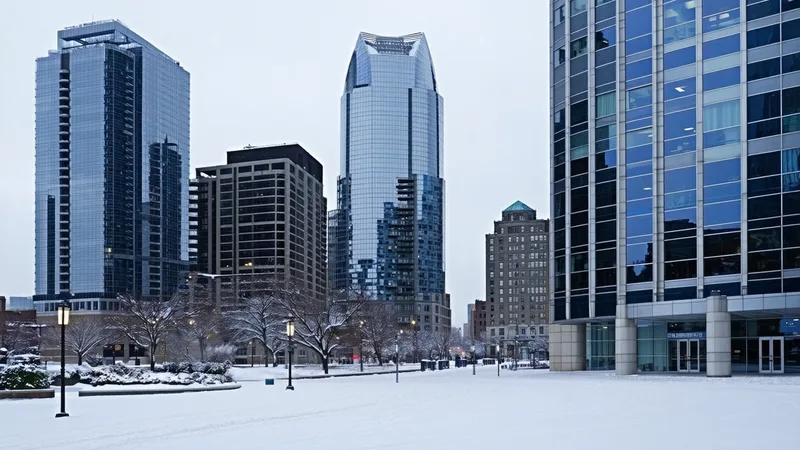
Minneapolis is none of those things. Building at 45°N with a continental climate and a 100°F annual temperature range — from -25°F polar vortex events in January to 95°F humid summer afternoons in July — forced us to rethink several assumptions that seemed reasonable on paper and failed consistently in the field. This is what we learned.
The Polar Vortex Problem: When the Model Has Never Seen This Before
Statistical forecasting models trained on historical data have a distributional assumption: future conditions will broadly resemble past conditions. For most commercial building load forecasting applications, this holds well enough. Weather in most climates follows relatively predictable seasonal patterns, and a model trained on 2–3 years of data has seen most of the relevant weather regimes.
During a polar vortex event — where a displaced Arctic air mass drops Minneapolis outdoor temperatures to -20°F or below for 2–3 consecutive days — the model is operating in the extreme tail of its training distribution. It has seen some cold days. It has not seen many days this cold, and the relationship between outdoor temperature and building heating demand is not linear at these extremes. Below approximately -10°F, several non-linear effects emerge:
- Envelope infiltration rate spikes: The pressure differential between indoor and outdoor at -20°F, combined with wind-driven infiltration at typical urban wind speeds (15–25 mph during polar vortex events), can add 20–30% to the effective heating load beyond what the envelope conductance calculation predicts at normal winter conditions.
- Mechanical system efficiency drops: Air-source heat pumps lose efficiency rapidly below 0°F and may switch to auxiliary electric resistance heating. Variable-frequency drives on air handlers operate at different efficiency points in extreme cold. The model's equipment efficiency assumptions need to be temperature-corrected at the extremes.
- Recovery time from setback expands non-linearly: Bringing a building from a 60°F overnight heating setback to a 70°F occupied setpoint takes roughly twice as long at -20°F outdoor temperature as it does at 0°F — not proportionally longer as a simple delta-T model would predict. Building skin thermal resistance has a different effective value when the boundary condition is this extreme.
Our response was to add a polar vortex regime flag to the forecast model that activates when the NWS forecast shows overnight lows below -10°F. In this regime, the model applies expanded pre-heating windows (typically 60–90 minutes earlier than normal), increases heating system staging assumptions, and applies a higher uncertainty band to the demand forecast output. The operator gets an explicit alert: "High-risk thermal day. Extended pre-heat window recommended."
Shoulder-Season Mode Switching: The Trickiest Transition
Minneapolis shoulder seasons — April and October — produce the most operationally difficult HVAC conditions we encountered. On a typical April day, the outdoor temperature might be 32°F at 6 AM and 62°F by 2 PM. The building needs heating in the morning and cooling in the afternoon. The HVAC system needs to transition between modes mid-day.
For a building with a two-pipe chilled water system (one pipe loop serving both heating and cooling coils, with a seasonal changeover), this transition is both an operational decision and a physical changeover that takes time. Switching from heating to cooling mode requires the chilled water loop to be purged of hot water and recharged with chilled water — a process that can take 30–60 minutes depending on system size, during which the building has limited ability to respond to thermal demand. Mistimed changeovers create either morning under-heating (switched to cooling mode too early, then outdoor temps drop overnight) or afternoon under-cooling (still in heating mode when solar loads peak).
Forecasting the heating-to-cooling transition day requires the model to predict not just tomorrow's temperature trajectory but the entire 72-hour profile — specifically whether the next 3 days will remain in cooling territory or whether there's a temperature reversal coming that makes changeover premature. A 72-hour forecast horizon is operationally necessary during shoulder season in a way that it isn't during stable summer or winter seasons.
Buildings with four-pipe systems (separate heating and cooling coil loops) have more flexibility because they can provide heating and cooling simultaneously in different zones without a full system changeover. But they're still subject to operational complexity during shoulder season, and the pre-conditioning logic needs to account for simultaneous heating and cooling zone demands — which a model designed for a single dominant mode doesn't handle well.
What Minnesota TOU Tariffs Look Like in Practice
The demand charge and TOU structure in Minnesota doesn't follow the same seasonal pattern as warmer climates. In California, demand charge risk is concentrated in summer — peak cooling demand drives the highest 15-minute intervals. In Minnesota, peak demand events can occur in both seasons, because winter heating demand spikes as frequently as summer cooling demand spikes.
Several Minnesota commercial utility tariffs apply summer and winter on-peak periods with different rate structures. Summer on-peak windows (typically June–September) are weighted toward afternoon cooling peak hours. Winter on-peak windows (December–February) include morning hours when heating demand spikes after overnight setback. A building that successfully manages summer cooling demand but ignores winter heating demand is only addressing half its demand charge exposure.
This is a nuance that many facilities managers miss when they think about demand management as a "summer cooling problem." For a Minneapolis office building, January and February demand events from heating recovery spikes are often comparable in kW to August cooling peaks. The pre-heating window management problem is symmetric with the pre-cooling problem — and requires the same forecast-based approach.
We're not saying warm-climate demand management techniques are wrong — they work fine in California. We're saying cold-climate buildings need a model that understands heating demand spikes as well as cooling demand spikes, and that shoulder-season transitions require a 72-hour horizon that warm-climate deployments can sometimes manage with less.
Humidity and Latent Load in Cold Climates
Cold-climate HVAC has a latent load challenge that warm-climate buildings rarely face in the same way: winter humidification. When outdoor air at -10°F is brought into the building for ventilation, its absolute humidity content is effectively zero — dry air at that temperature holds almost no moisture. Conditioning that ventilation air to occupied space conditions (70°F, 40% relative humidity) requires adding significant moisture, which the humidification system does using steam or evaporative humidifiers that draw substantial power.
In a building with a large outside air fraction (typically required for ASHRAE 62.1 compliance in high-occupancy spaces), humidification load during cold polar vortex events can add 50–80 kW to the HVAC electrical draw — load that appears during the same morning startup window as the heating demand spike. A forecast model that doesn't account for humidification load during extreme cold events will systematically under-predict demand during the highest-risk winter mornings.
We added outdoor dewpoint as an explicit forecast input — in addition to dry-bulb temperature — specifically to capture the humidification load component during extreme cold events. The model now distinguishes between a -20°F dry polar vortex day (low dewpoint, high humidification load) and a more moderate winter day, and the pre-heating window recommendations reflect that difference.
What This Means for Non-Minneapolis Buildings
The lessons from Minneapolis aren't specific to Minneapolis. Any building in ASHRAE Climate Zone 6 or 7 — the northern tier of the US, most of Canada — faces the same combination of extreme heating season demand, heating-to-cooling shoulder-season transitions, and year-round dual-peak demand structure.
Buildings in Climate Zone 5 (Chicago, Detroit, Boston, Denver) face somewhat milder versions of the same challenges. The polar vortex events are less severe, the annual temperature range is smaller, but the shoulder-season mode-switching problem and the winter morning heating recovery spike are still present and still drive demand charges in ways that warm-climate forecasting models don't capture well.
The practical implication for any building energy manager in the northern US: if you're evaluating a thermal demand forecasting vendor, ask them specifically how they handle extreme cold events and heating-to-cooling transitions. A model that was trained primarily on warm-climate buildings and then deployed in Minneapolis will exhibit systematic forecast errors in January and April — exactly when demand charge risk is highest.