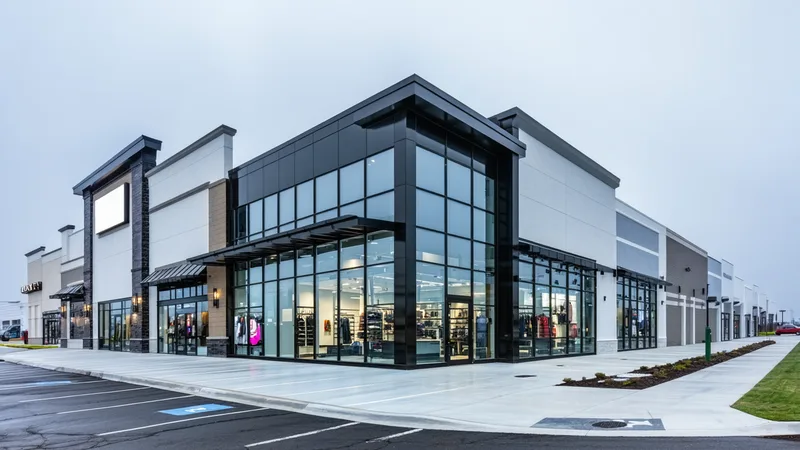
Office buildings have predictable occupancy patterns, and even with hybrid work variability, they follow a weekday-weighted logic that a statistical model can learn relatively quickly. Retail buildings are different. Foot traffic in a commercial retail setting varies by hour-of-day, day-of-week, week-of-year, weather conditions, and promotional calendar in ways that produce a much noisier occupancy signal than office buildings generate. And yet most retail HVAC systems are controlled by the same fixed-schedule BMS programs used in offices — seven-day schedules with time blocks, tuned once at commissioning and rarely revised.
The mismatch between occupancy volatility and control rigidity in retail creates a specific demand charge profile: high peak events on crowded weekend afternoons when the schedule wasn't set for the actual load, and unnecessary conditioning on slow weekdays when the schedule pre-cools for a crowd that doesn't arrive. Addressing this requires a forecast approach designed for retail occupancy dynamics, not adapted from office building models.
The Retail Occupancy Pattern
A mid-size regional shopping center or standalone big-box retail facility typically has a weekly foot-traffic pattern that looks roughly like this: Monday through Thursday are the lowest weekdays, Friday begins picking up in afternoon hours, Saturday is the weekly peak (typically 3–5x Monday traffic), and Sunday is second-highest. Holiday weekends — the week before Thanksgiving, the weeks around the December holidays, back-to-school August weekends — can produce foot traffic 2–3x the typical Saturday peak.
The HVAC implications of this pattern aren't just about total daily load — it's about when within the day the peaks occur. A typical Saturday retail peak is 2–5 PM, when both foot traffic and outdoor temperature are at their highest simultaneously. The morning pre-conditioning load is substantial because the building needs to be cool by 10 AM for store open, but the afternoon sustained load is the demand charge risk period. Saturday afternoons in summer are frequently the highest monthly demand events for retail HVAC systems.
Compare this to the office building pattern where morning ramp-up is the primary demand event. In retail, the primary demand event is an afternoon sustained load on a high-traffic, high-temperature day. Pre-conditioning strategy, staging decisions, and load-shifting approaches need to be calibrated to this different risk window — not to the morning-ramp frame that most demand management literature focuses on.
Foot-Traffic Data Sources for Retail
Retail environments have richer occupancy data infrastructure than office buildings because foot traffic is a business metric — it's tracked for merchandising, staffing, and revenue analysis, not just HVAC control. The data sources that are typically available:
People counter systems. Most large retail facilities have automated people counting at entry doors, using infrared break-beam sensors, overhead LiDAR sensors, or video-based counting systems. These produce hourly or 15-minute entry/exit counts with accuracy typically in the 90–95% range for properly calibrated systems. For HVAC purposes, the cumulative in-store count (entries minus exits plus baseline staff count) is the relevant occupancy metric, which requires combining entry and exit counts rather than just entry counts.
POS transaction timestamps. Point-of-sale transaction data provides a slightly lagged but highly reliable proxy for in-store activity. Transaction rates correlate strongly with in-store occupancy and can be used as a model validation input even when people counter data isn't available. The advantage of POS data is that it's typically already centralized and accessible through retail management systems — unlike people counter data, which may require local extraction from door controller hardware.
Parking lot occupancy. For standalone retail buildings or shopping centers with parking structures, parking occupancy data (from gate systems or video-based parking sensors) provides an occupancy lead indicator — parking fills up 10–20 minutes before peak in-store occupancy. Parking data can be used as an early-warning input that adjusts cooling staging ahead of the in-store peak.
Historical traffic by date type. Retail operators typically maintain promotional calendars with marked event dates — sales events, product launches, community events — that historically drive traffic spikes. Integrating the promotional calendar into the occupancy forecast model adds explicit event signal that pure time-series models miss.
A Scenario: Summer Weekend Demand Management at a Regional Mall
Consider a 300,000 sq ft enclosed regional mall in the Minneapolis area, with a central chilled water plant and zone-level VAV distribution. A typical hot Saturday in July produces the following HVAC challenge: outdoor temperatures reach 88–92°F by 2 PM, foot traffic peaks at 3,500–4,000 in-store visitors between 1 and 4 PM, solar loads on the south-facing skylights are maximum, and the chilled water plant runs at 85–95% capacity for 4–5 consecutive hours.
The BMS schedule pre-cools starting at 6 AM to reach 71°F by 10 AM open. On a normal summer Saturday, this works reasonably well — the building arrives at 71°F with 20 minutes of margin before doors open. But on a high-traffic day with 15% above-average foot traffic (an arts festival in the adjacent outdoor area, or a summer sale event), the additional latent and sensible load from higher occupancy pushes temperatures up faster than the schedule anticipates. By 2 PM, zone temperatures in high-traffic areas are approaching 74–75°F, the chiller is running at 100% staging, and the 15-minute peak demand intervals are setting the monthly demand charge.
A foot-traffic forecast that identifies this as a high-occupancy event 24–48 hours ahead allows two adjustments: an earlier and deeper pre-cooling window (start at 4:30 AM, target 69.5°F by 9:30 AM), and a staging schedule that starts reducing output at 1:30 PM (when the thermal buffer is still sufficient to carry the building 45 minutes at lower staging) rather than waiting for temperatures to rise and then reacting. The demand peaks are lower, less sustained, and don't set the monthly record.
We're not saying foot-traffic forecasting for HVAC is straightforward — retail occupancy variability is genuinely harder to model than office occupancy. We're saying the data infrastructure is typically already in place, and the demand charge exposure on high-traffic summer weekends is large enough to justify the integration work.
The Latent Load Complication
Retail buildings have a latent load challenge that makes occupancy-based demand forecasting more complex than simple headcount would suggest. Each occupant generates approximately 250 Btu/hr of sensible heat and 200–250 Btu/hr of latent heat (moisture) through respiration and perspiration. In a 100,000 sq ft retail space with 1,000 occupants on a humid summer day, the latent load from occupants alone is approximately 200,000–250,000 Btu/hr — a substantial fraction of total cooling load that the chiller must remove as dehumidification, not just temperature reduction.
The latent load compounds with outdoor humidity because retail buildings have high outdoor air ventilation requirements (per ASHRAE 62.1, retail occupancies require significant minimum outdoor air per person). On a 90°F/70% RH summer day, conditioning that outdoor air to 72°F/50% RH requires removing a substantial latent load before any occupant moisture is even considered.
A thermal demand forecast that uses a dry-bulb-only weather model will systematically under-predict retail cooling demand on humid days because it's missing the latent load component. The forecast needs to incorporate outdoor dew point or relative humidity alongside dry-bulb temperature to produce accurate cooling load predictions during humid summer conditions — which is precisely when retail demand charge risk is highest.
Energy Intensity Benchmarking for Retail
ENERGY STAR and the Commercial Buildings Energy Consumption Survey (CBECS) provide energy intensity benchmarks for retail building types that are useful for contextualizing whether a particular building's demand profile is typical or outlier. Retail properties typically range from 15–35 kBtu/sq ft/year for total site energy, with electricity-intensive big-box retail at the high end. HVAC typically represents 35–50% of total electricity in enclosed retail buildings — somewhat lower than office buildings because of the higher lighting and plug load density in retail merchandising spaces.
If a retail building's demand charges represent more than 30% of total utility spend, or if the peak demand is more than 3x the average demand (load factor below 33%), there's typically significant room for improvement through demand smoothing strategies. The foot-traffic forecast integration described here — combined with appropriate pre-conditioning adjustments for high-occupancy event days — typically reduces retail peak demand events by 12–22% in buildings where the pre-existing BMS schedule was not event-aware. The improvement is most pronounced on the 5–8 highest-traffic days per year, which are also the days that historically set the annual peak demand record.